

What Forward Deployed AI Engineering Actually Is
The most important new role in B2B software is the one almost nobody can define correctly. By the end of this article, you will.

I have been doing Forward Deployed AI Engineering for two years. I have also talked to a few dozen other operators in this space. Some at frontier AI labs running their new deployment subsidiaries, some are running their own independent practices, some are embedded inside enterprises as the first internal AI engineer.
The definitional confusion is real. Half the people calling themselves Forward Deployed AI Engineers are doing AI consulting with a more interesting title. The other half are doing in-house engineering at companies that need senior AI talent. Neither group is wrong about what they do. They are both wrong about what to call it.
By the end of this article, you should be able to draw the lines cleanly. You should know where Forward Deployed AI Engineering comes from, what makes work “Forward Deployed” specifically, what it isn’t, and why this is suddenly the most important new role in B2B software.
Where the term comes from
The category was invented at Palantir in the late 2000s.
The textbook example, the one everyone in the space cites, is Afghanistan in 2010. Palantir Forward Deployed Engineers embedded with US Special Forces. Operators ran missions during the day. They came back with feedback about what the software was missing, what was confusing, and what had failed in the field. The FDEs shipped code overnight. The next day’s missions used the updated software.
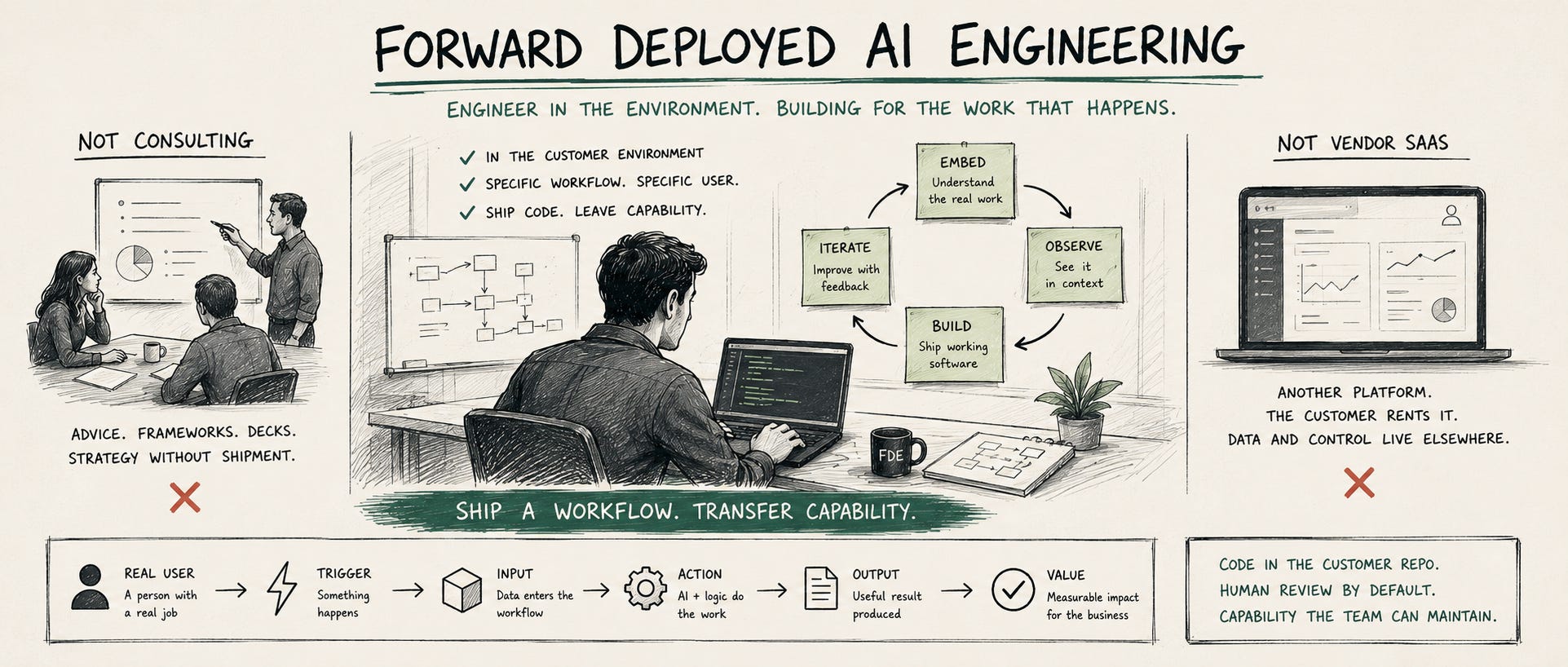
That cycle (embed, observe, ship, observe again) is the entire concept. The FDE doesn’t sit at headquarters and read tickets. The FDE is in the room where the work happens, watching the work happen, building software for the specific conditions of that environment.
Palantir’s CTO has said publicly that you cannot build products for an environment without being in the environment. That isn’t a slogan. It is the operating principle. Everything that distinguishes Forward Deployed work from adjacent work follows from it.
For 15 years, this was a defense-industry idea. Some bank engineering teams adopted versions of it. A few consulting shops borrowed the language. Most of the software industry kept selling SaaS at a distance and didn’t think about it much.
Then AI happened, and everyone needed it again.
Why the role is back, and bigger than before
Three things are simultaneously true in 2026, and together they explain why Forward Deployed AI Engineering has gone from a niche defense-industry idea to the most-discussed new role in B2B software.
Model intelligence has commoditized. The frontier models (Claude, GPT, Gemini, and the rest) are roughly fungible for most workflows a B2B company would want to ship. Two years ago, picking the right model was a meaningful decision. Today, it is largely a coin flip. The model is no longer the product. It is becoming infrastructure.
Deployment hasn’t commoditized. Picking the right workflow, scoping it correctly, integrating with the customer’s actual stack, defining what “good output” means, building the eval loop, and handing it off so the customer’s team can maintain it: none of that is solved. None of it is going to be solved by the model getting smarter, because none of those problems are model-intelligence problems. They are problems of judgment, integration, and operational fit. They require someone who is in the room.
Every B2B company has board-level pressure to ship AI. Investors are asking. Competitors are shipping. Customers expect it. The pressure is real and timed.
Stack those three together, and you get the conditions that produced Palantir FDEs in 2010, but at a much larger scale. The customer’s environment is the bottleneck. The bottleneck can only be addressed by an engineer with judgment embedded in the environment.
That is why OpenAI launched a $10B subsidiary called The Deployment Company. That is why Anthropic launched a similar deployment arm in the same 24-hour window. That is why every applied AI startup is suddenly hiring for this role. The bet is identical: the future of AI revenue is not better models. It is the engineering work that turns the existing models into a shipped product inside customer operations.
What makes work “Forward Deployed”
Three things, and all three have to be present. Take anyone away, and the work becomes something else.
One. The engineer is in the customer’s environment, not in a vendor environment.
The work happens inside the customer’s repo, the customer’s data layer, and the customer’s existing tools. Not on a vendor platform that the customer logs into. The deliverable is code committed to the customer’s codebase, not access to a SaaS dashboard. If the customer stopped paying tomorrow, the work would still be in their system, still running.
This is the line that separates Forward Deployed Engineering from vendor delivery. Most “AI deployment” work being marketed today is actually vendor delivery: a product the customer rents, hosted somewhere the customer doesn’t control, accessed through credentials they don’t own. That is a legitimate business model. It isn’t Forward Deployed.
Two. The work is scoped to a specific workflow with a specific user, not a general capability.
Forward Deployed work doesn’t produce “an AI feature for your product.” It produces a specific workflow that a specific user runs, with a clear input and a clear output. The investor update workflow that a founder runs once a month. The support ticket triage workflow that a customer success manager runs every morning. The sales call summary workflow that an account executive runs after every demo.
This is what distinguishes Forward Deployed Engineering from AI consulting. Consultants ship strategy, recommendations, frameworks, decks. Forward Deployed Engineers ship workflows: single, specific, named processes that a specific person on the customer’s team will use. If you can’t name the user, you don’t have a Forward Deployed engagement. You have a consulting engagement with extra steps.
Three. The engineer carries judgment, not just typing.
A Forward Deployed Engineer is not a contractor executing the customer’s instructions. They are an operator with their own view about what should be built, in what order, and how, with what success criteria. They will tell the customer no. They will refuse to build the workflow the customer arrived with if it is the wrong workflow. They will rescope mid-engagement if the original scope isn’t going to ship.
This is the line that separates Forward Deployed Engineering from freelance engineering. Freelancers execute. Forward Deployed Engineers decide. The customer is paying for the second one, and the first one as a side effect.
What Forward Deployed AI Engineering is not
Three categories of work get mistaken for Forward Deployed AI Engineering, and shouldn’t be.
It is not AI consulting. AI consulting produces strategy artifacts: decks, roadmaps, recommendations, frameworks. Useful work, often expensive, but it doesn’t include shipping anything to the customer’s product. The deliverable is paper. Forward Deployed work’s deliverable is running code.
It is not freelance AI engineering. Freelance AI engineers ship code, but they ship code that the customer specified. They don’t carry judgment about what to build. They take a ticket, build the ticket, and close the ticket. Forward-deployed work includes the decision of what the ticket should be in the first place.
It is not vendor product delivery. Buying an AI SaaS product and integrating it into your workflow is legitimate, fast, and often the right answer for many problems. But it isn’t Forward Deployed Engineering. The vendor isn’t in your environment. They don’t see your data. They built one product for thousands of customers, not one workflow for you.
The distinctions matter because they predict the work. If you buy AI consulting expecting Forward Deployed Engineering, you’ll be disappointed when no code ships. If you buy Forward Deployed Engineering expecting a SaaS product, you’ll be disappointed when the work doesn’t run without your engineers maintaining it. If you buy freelance engineering expecting forward-deployed work, you’ll be disappointed when the engineer keeps asking what to build instead of telling you.
Who buys Forward Deployed AI Engineering, and why
Two distinct buyer profiles right now.
Fortune 500 enterprises buy from the frontier-lab deployment subsidiaries (OpenAI’s Deployment Company, Anthropic’s deployment arm) or from the larger applied AI shops. Engagement sizes north of $250K. Procurement cycles are measured in quarters. Multi-stakeholder buying processes with security review, legal review, and procurement review. The work targets large workflows touching many users: internal tooling for thousands of employees, customer-facing workflows in regulated industries, and enterprise-scale automation.
Founder-led companies in the 5-to-500-person range buy from independent operators or smaller applied AI shops. Engagement sizes from a few thousand dollars to the low six figures. The CEO is in the room. Decisions are made in days, not quarters. The work targets specific workflows that move specific metrics: the support ticket triage that is bottlenecking customer success, the investor update workflow that is eating the founder’s Sundays, and the document extraction workflow that is slowing down operations.
Both buyer profiles want the same shape of work. They just have different procurement clocks and different budgets. The independent operator running engagements for founder-led companies in 2026 is doing the same job that the frontier-lab deployment engineer is doing for the Fortune 500. Same role, different container.
Why this matters more than people realize
The reflexive frame on AI right now is “the model will keep getting smarter, and that will change everything.” It will keep getting smarter, but at some point (possibly already passed), the model gets smart enough that the bottleneck moves.
The bottleneck moved to deployment. That is why the frontier labs are spending billions on deployment subsidiaries. That is why every B2B SaaS company is suddenly looking for someone who can ship AI workflows. That is why the term “Forward Deployed Engineer” has gone from defense-industry jargon to the most-discussed role in tech in the span of a single year.
The companies that win the next 18 months in B2B AI will not be the ones that picked the best model. They’ll be the ones who put the model into shipped, useful workflows fastest, with the most judgment about which workflows mattered. That is Forward Deployed AI Engineering.
If you are a founder under board pressure to ship AI, this is what you should be buying: not consulting, not vendor SaaS, not freelance engineering. If you are an engineer trying to figure out what to build a career around for the next decade, this is the role that is about to compound. If you are an investor trying to figure out where applied AI revenue accrues, watch the deployment shops, not the model labs.
TLDR
Forward Deployed AI Engineering is the embedding of an engineer-with-judgment inside a customer’s operation, shipping specific workflows into the customer’s product and infrastructure.
The term comes from Palantir in the late 2000s. The textbook example is FDEs embedded with Special Forces in Afghanistan in 2010: observe in the field, ship code overnight.
Three things make work “Forward Deployed”: the engineer is in the customer’s environment (not a vendor environment), the scope is a specific workflow (not a general capability), and the engineer carries judgment (not just executes tickets).
It is not AI consulting (deliverable is strategy, not code), not freelance engineering (no judgment about what to build), and not vendor SaaS delivery (vendor isn’t in your environment).
The role exists at two scales: frontier-lab deployment subsidiaries serving Fortune 500, and independent operators serving founder-led companies. Same role, different procurement clocks.
The model is no longer the bottleneck. Deployment is. The companies that win B2B AI in the next 18 months will be the ones that shipped the most workflows, not the ones that picked the smartest model.