

The model: the lunch is never free
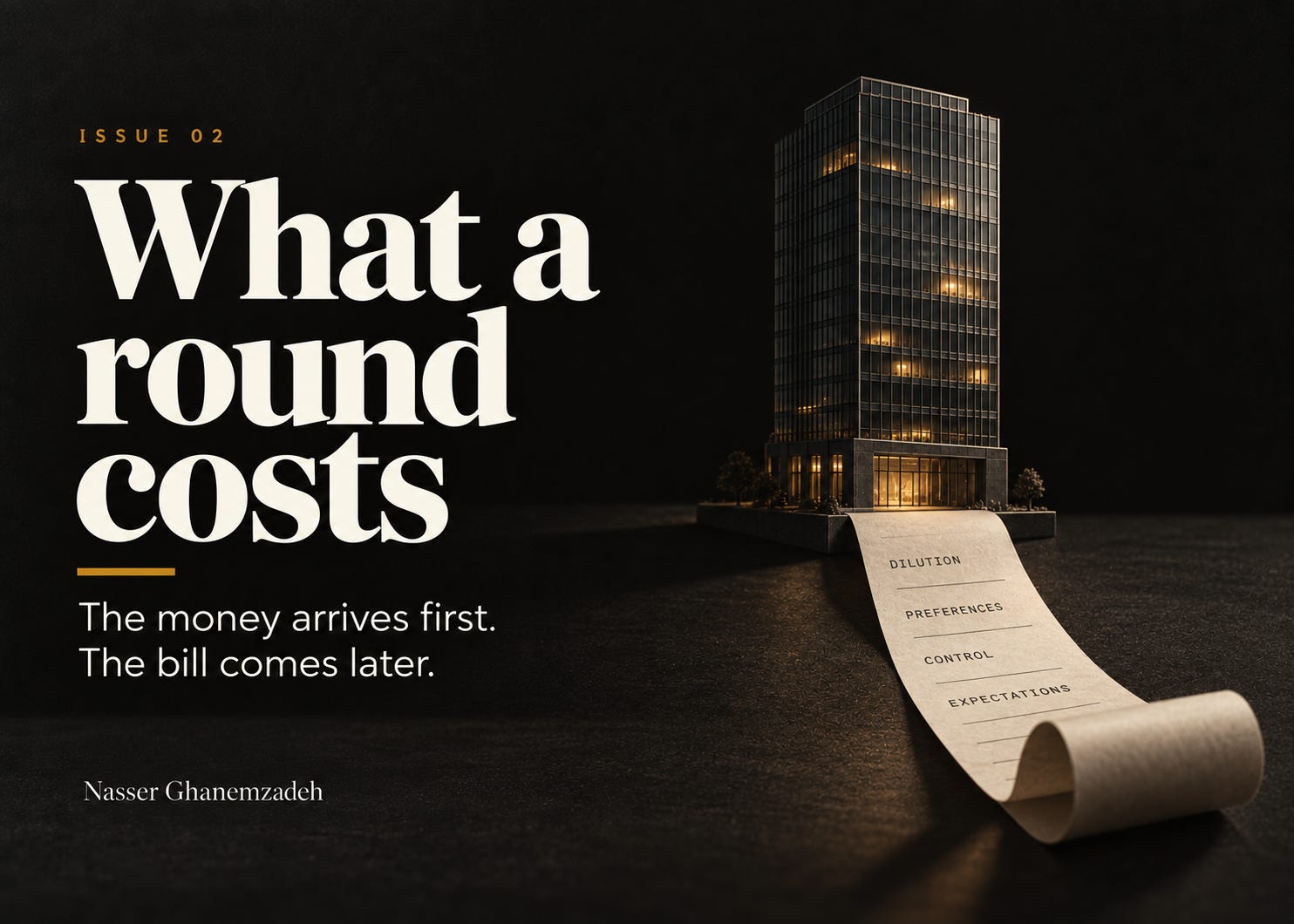
A financing round arrives as pure oxygen, and its costs arrive on delay, which is why they deserve a day of daylight. There are four of them, in rising order of invisibility.
Dilution is the visible one, and even it is chronically under-computed. Founders price the round they are raising and forget the rounds to follow. Sell 20 percent four times and the majority is gone. Preferences are the second: the investor’s dollars come out first in a sale, which converts many “successful” mid-size exits into founder-and-employee zeros. The waterfall, the clause that says who is paid in what order, deserves reading before the valuation deserves celebrating. Control is the third: board seats, veto rights, and consent requirements are permanent constitutional amendments purchased with temporary money. And expectations are the fourth. Capital at a given valuation is a promise of scale. The quiet $30 million exit that would change a founder’s family’s life becomes contractually uninteresting to a fund that needs billion-dollar outcomes. The founder has adopted someone else’s game, with its horizon and its required winnings.
From the investor’s chair the same list reads backward, and it is worth reading, because the check writer pays two of the four costs too. You buy the preference and the control, and you inherit the expectation. A seed check at a valuation that assumes a land grab commits you to funding a land grab, or to watching your position get crushed in the down round that follows when the grab does not happen. So the question before wiring is whether this is a rocket opportunity, where the market is a land grab and speed is the strategy, or a good business dressed as one because the founder has noticed that rockets get funded. For everything that is not a rocket there is revenue and patience.
The founder’s odds compound the problem. In 1988 Arnold Cooper, Carolyn Woo, and William Dunkelberg surveyed nearly 3,000 new business owners. Eighty-one percent put their own chances of success at seven in ten or better, and a third put them at ten in ten. The base rate says most attempts fail. Optimism about the mission is fuel. Delusion about the odds is a steering error, and the round is where the delusion gets written into a legal document.
Which is where the pitch comes in. Storytelling is in the founder’s job description: the pitch that raises capital, the vision that recruits engineers away from safe salaries, the narrative that makes a small company feel inevitable to customers. Belief recruits reality, and the founder is the chief recruiter. The occupational disease is that the storyteller is the story’s most exposed audience. Rehearse the pitch two hundred times and performance converts into belief. The projections become expectations, the vision becomes the plan of record, and the founder is soon steering by a document originally drafted to sell.
The defense is two sets of books, legitimately kept. The external story, optimized for inspiration and true. The internal mirror, optimized for accuracy and cold: the real cash numbers, the kill conditions, the decision journal. One person has to read both daily without confusing them. The investor’s version of the rule is simpler. You are being handed the story. Ask for the mirror. If the mirror quotes the pitch, you have learned what you came to learn.
One more page from this week matters before the case. Day one has no moat, and the honest founder says so. What a check should buy is an acorn: an advantage too small to dignify with the word, that deepens with operation. Speed of response, or depth in one narrow niche. The test of a real proto-moat is that every customer served makes the next one easier to win or harder to lose. Advantages that do not accumulate, a feature or a price, are treadmill speed, spent as they are earned.
The case: the story, the mirror, and $47 billion
WeWork filed its S-1 on August 14, 2019. The mission statement was in the first two sentences: to “elevate the world’s consciousness.” That was the story, and it had worked. SoftBank had put in another $2 billion in January at a valuation of $47 billion.
The mirror was in the same document, a few hundred pages on. Revenue in 2018: $1.82 billion. Net loss in 2018: $1.9 billion. The first half of 2019: $1.54 billion of revenue against more than $900 million of loss. The business took offices on leases of a decade or more and rented desks by the month, so every new location added a fixed obligation against a variable customer. The governance section read like a founder’s wish list. Adam Neumann’s shares carried 20 votes each. He had sold the trademark “We” to his own company for $5.9 million. A provision gave his wife a role in choosing his successor. And the Wall Street Journal had reported in July that he had already taken around $700 million out through stock sales and loans against his shares.
Run it through the model.
All four costs were in the filing, and all four had been paid by investors rather than by the founder. Control: the rounds had sold Neumann permanent constitutional power in exchange for temporary money, the founder’s page read in reverse. Expectations: $47 billion was a promise of scale the mirror could not honor, and once the public market declined to inherit the promise, the private investors owned it alone. Preferences: when the valuation reset in October, to a figure reported at about $8 billion, with SoftBank paying roughly $9.5 billion more for control, the waterfall decided who absorbed the difference, and the people furthest down it were employees holding options struck against the story. Dilution, the visible cost, turned out to be the least of it.
The proto-moat test fails on the numbers. Each customer served did not make the next one cheaper to win or harder to lose. Each location added ten years of lease against tenants who could leave in thirty days. The advantage was treadmill speed, and the treadmill had a $47 billion sponsor.
And the story ate its storyteller, exactly as the page predicts. Neumann had pitched Masayoshi Son in a meeting reported to have lasted twelve minutes and walked out with billions. Some hundreds of retellings later, the mission statement was on page one of a securities filing, where the audience reads the mirror first. Six weeks after the S-1, the IPO was withdrawn. Neumann was out as chief executive by the end of September.
The investor’s lesson is uncomfortable, because the mirror was public and free. Nobody needed a leak. The S-1 was the internal book, published, and the price had been set by the external one. The people who paid for the story had the mirror on their desks the whole time and read it as a prospectus. The founder, meanwhile, had done the one thing the odds page recommends, and done it before anyone else: he had taken money off the table.
[Optional, yours: the seed term sheet you signed or declined where the waterfall, and not the valuation, decided the outcome. Two or three sentences, details changed.]
The tool: the round-cost sheet
Before wiring, fill in four lines with the founder in the room. If the founder cannot fill them, that is the fifth line.
Dilution, four rounds out. Take the founder’s ownership today and apply the next three expected rounds at plausible sizes. Sell 20 percent four times and 41 percent remains. Ask for the founder’s own number before showing yours.
The waterfall at three exit sizes. Small (the life-changing acquihire, say $30 million), medium (the fund-returning outcome the deck implies), grand (the last slide). Who gets what, in what order, under the preference stack as drafted. If the small exit pays the founder nothing, you have just learned what they will fight for and what they will let go.
Control. List every consent right, veto, and board seat the round creates, and write next to each the year it expires. Most never do.
The acorn. Name the one advantage that gets stronger with every week of operation. If the answer is a feature or a price, it is treadmill speed. If it is speed of response, or a niche where the product is superb for one narrow user, it is an acorn, and the check is watering it.
Then the mirror question, asked out loud: which number in this deck is presented most favorably, and what is its unfavorable version? A founder who answers inside ten seconds keeps two sets of books. A founder who has to think keeps one, and it is the pitch.
The pages behind this letter: October 9 to 16 in Daily Wisdom, from “What a round costs” to “The story and the mirror.” Nothing here is investment advice; the letter is about the quality of decisions, not returns. Reply with the decision you are facing. The ones I can use, with the details changed, become cases.
P.S. Daily Wisdom ships next Tuesday, October 6. Pre-orders arrive on launch day: [AMAZON LINK].