

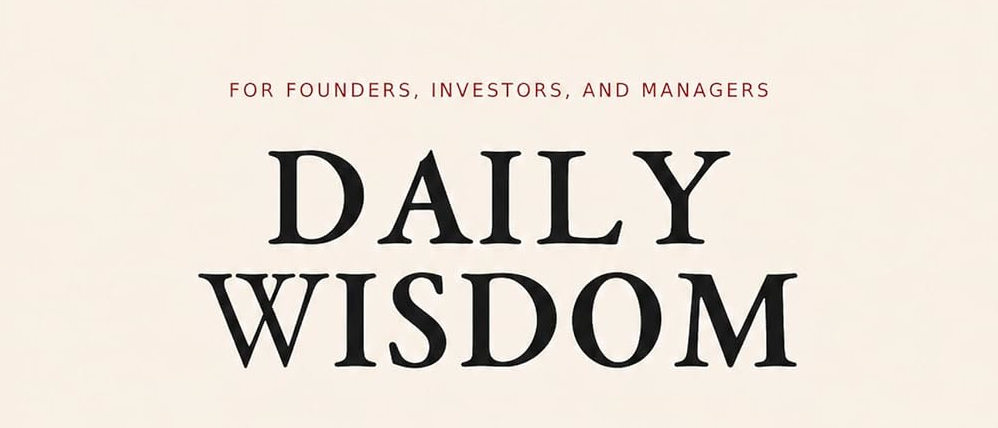
For the last several years, I have had three books open at the same time. Nobody recommends this, and I would not recommend it either. The third one I started, Forward Deployed AI Engineering, shipped first because a book about a job that is still being defined has to come out while the definition is up for grabs. The second, Founder Mode, is almost finished. The first one I started is the one in front of you today: Daily Wisdom for Founders, Investors, and Managers. 366 meditations on mental models, misjudgment, and money. One page a day, for every day of a year.
I wrote it because I wanted to read it and could not find it.
Where it comes from
In 2003, a Swedish businessman named Peter Bevelin published a strange and wonderful book called Seeking Wisdom: From Darwin to Munger. He said he wrote it to learn, collecting in one place what Charles Darwin, Charlie Munger, Warren Buffett, and a hundred scientists and philosophers had figured out about why we misjudge and how to do better. It became an underground classic among investors and founders, passed hand to hand like a map.
I have read most of the shelf that grew up around that book, and I will read more of it. What I kept wanting was a daily dose of the same material: one idea, one page, every morning, the way a supplement delivers a vitamin. The daily form is old. Tolstoy spent his last years assembling A Calendar of Wisdom. A century later, Ryan Holiday’s The Daily Stoic and Robert Greene’s The Daily Laws proved the form still works. It works because wisdom behaves like a practice, and practices run on repetition. You cannot read your way into better judgment in a weekend. You might, page by page, over a year, train your way into it.
None of those books was written for the person who decides with money on the line, their own and other people’s. The idea for that book is the oldest of my three. The writing started in February 2024. It is finished now.
Who it is for
The pages rotate among a founder, an investor, and a manager, because the jobs share one craft: making decisions under uncertainty with other people’s trust at stake.
If you have built a company and now write angel checks, sit on a board, run a small fund, or hold most of your net worth in one position, you do all of those jobs in the same week. You price a round on Tuesday and a hire on Thursday. You are the investor being pitched and the founder who remembers being pitched. Most pages speak to all three jobs. Every page speaks to the person underneath the job.
What is in it
The year follows Bevelin’s map. January builds the latticework, Munger’s idea that knowledge only works when models from many disciplines hang together. February and March cover the psychology of misjudgment: the twenty-eight standard ways our minds fool us, by Bevelin’s count, and the antidotes. April is the mathematics of wisdom. May reads business through Darwin’s eyes. June is systems and second-order effects. July is the psychology of money, in Morgan Housel’s territory. August is the investor’s temperament, September the manager’s craft, October the founder’s path. November is the not-to-do list, which turns out to be most of the game. December asks what all of it is for.
The first page starts with arithmetic. One bad hire costs a year. One bad acquisition costs a decade. One bad partner can cost you the company. Avoided mistakes compound like invested money, and almost nobody studies avoidance. The book is 366 days of studying it.
Each page has a quotation, a short essay, and a closing prompt: a question to sit with or a small action to take. The prompt is the point. Reading takes three minutes. The page only pays if the prompt survives into your day.

Three promises
Every quotation was verified against a primary source before it went in: the original text, the original letter or speech, the shareholder letter on the company’s own site, or a scholarly edition. The internet attributes almost anything to almost anyone. The famous line about the survival of “the most adaptable to change,” credited everywhere to Darwin, appears nowhere in Darwin. A management professor named Leon Megginson wrote it in 1963. “It is better to be vaguely right than exactly wrong” was written by Carveth Read in 1898. Keynes never said it. Where a beloved quotation could not be verified, it was left out rather than hedged.
The ideas are credited. Where a framing belongs to Munger, Buffett, Housel, or Bevelin, their name is on it. The connective tissue and the mistakes are mine.
Nothing here is theory I have not needed. I have spent my working life building software and companies, including one I ran from zero to acquisition, and every chapter is something I learned the expensive way or watched someone else pay for.
How to use it
Start on today’s date, or on January 1, or anywhere. The year is a circle; you will pass every page eventually. Keep a notebook, because many prompts ask you to write and the writing is where the thinking happens. Then reread. The same page reads differently in a bull market and a bear market, before a decision and after one.
What this letter becomes
This newsletter changes along with the book. From Sunday, October 4, one letter a week, built the same way every time: one model from the book, one real decision run through it (a deal, a hire, a board vote, an exit; sometimes mine, always verified or anonymized), and one tool you can use on Monday.
The daily pages will also arrive as their own short email, one quotation and one prompt each morning, for anyone who wants the habit without the book.
Reply to this email with the decision you are facing right now. The ones I can use, with the details changed, become the cases.
The book is on Amazon: [AMAZON LINK]. Independent books find their readers through honest reviews. If this one earns yours, that is where it counts.
Nasser