
Forward Deployed Engineering Without the $250K Floor
Why the hottest role in tech needs to exist in two sizes, and why most founder-led B2B SaaS companies are quietly being priced out of the one they actually need.

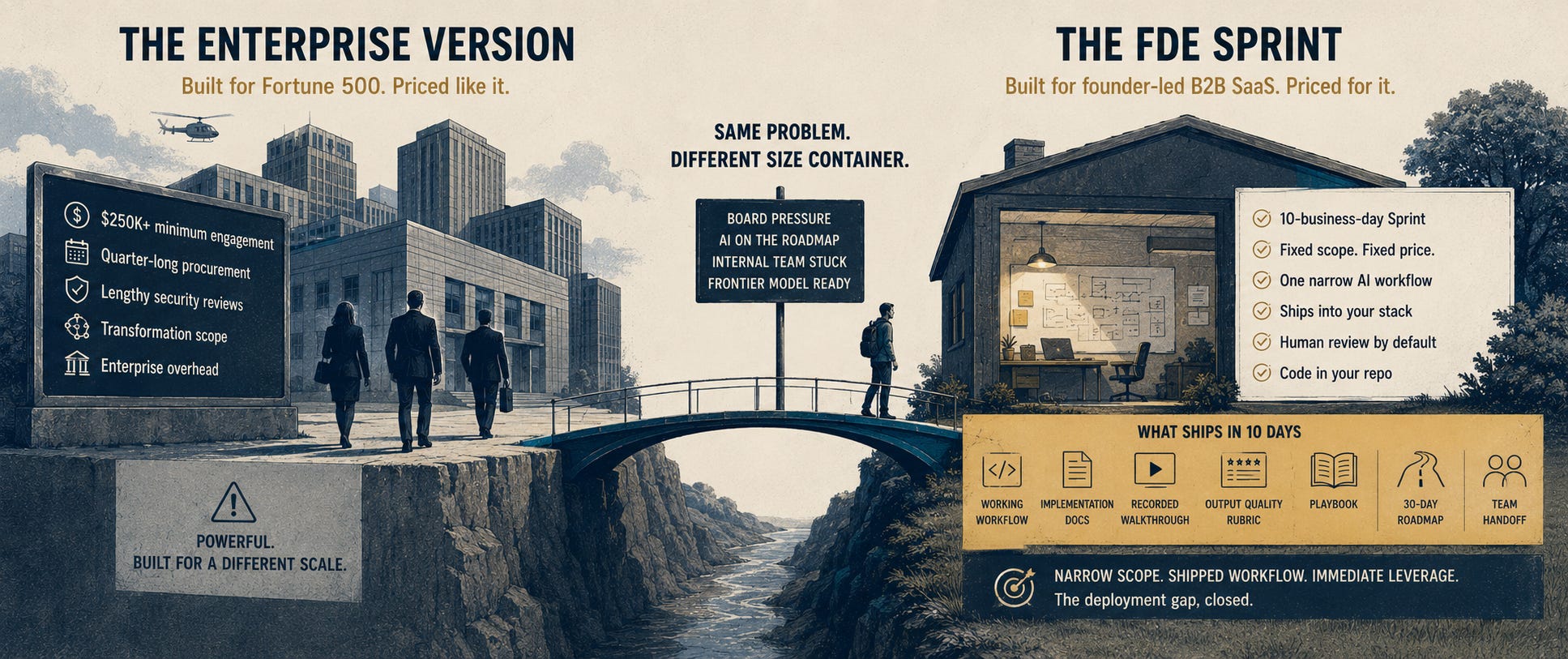
By the end of this article, you should understand why Forward Deployed Engineering has split into two sizes this year, what the smaller size looks like in practice, and why a 20-person B2B SaaS company should never try to buy from the larger one.
I run Forward Deployed AI Engineering for founder-led B2B SaaS companies, typically 5 to 50 employees, post-product-market-fit, with paying customers and a board asking about AI. The work is the same shape as what Palantir invented, what OpenAI just spent $10B launching The Deployment Company to do, and what Anthropic launched its own deployment arm to do in the same 24-hour window. It is also priced roughly 50x lower, runs in 10 business days rather than quarters, and ships a single, narrow workflow into the customer’s product rather than an enterprise transformation.
The category split happened quietly. Most founders haven’t noticed yet. This is the article I wish had existed when I started.
Why FDE had to split into two
The original case for Forward Deployed Engineering is durable: you cannot build software for an environment without being inside the environment. Palantir proved this in 2010 with FDEs embedded with US Special Forces in Afghanistan. Operators ran missions during the day, fed feedback back, and FDEs shipped code overnight. The principle works for any complex domain. It works for AI now.
In 2026, two of the largest AI labs in the world made the same bet within 24 hours of each other. OpenAI launched The Deployment Company, a $10B subsidiary. Anthropic launched a similar deployment arm. Both bets are on the same thesis: the frontier model is no longer the product. Deployment is.
Both bets are aimed at the same buyer: Fortune 500 enterprises. Minimum engagement sizes north of $250K. Procurement cycles are measured in quarters. Security reviews that take longer than the actual work. That makes sense. The unit economics of an in-person engineering deployment at frontier-lab pricing only clear at enterprise scale.
The problem is that the 20-person B2B SaaS company is now in the same situation as the Fortune 500, in three specific ways.
One. They have board-level pressure to ship AI features this year. Investors are asking. Competitors are shipping. Customers expect it.
Two. Their internal team doesn’t know how to scope or ship AI workflows. Someone tried a prototype. Someone suggested a chatbot. Nothing has reached production.
Three. The frontier model is sitting unused. It is capable of doing exactly what their roadmap needs, except for the deployment piece.
But they cannot buy from The Deployment Company. The procurement process alone would consume more time than the work itself. They cannot run a quarter-long security review for a two-week engagement.
That is the gap. Same problem, different-sized container.
What FDE looks like below the enterprise floor
Same delivery shape as the enterprise version. Smaller everything else.
The unit of work is a 10-business-day Sprint that ships one narrow AI workflow into the customer’s product. Fixed scope. Fixed price. Code committed to the customer’s repo on Day 10. Not a strategy deck, not a roadmap, not a chatbot the marketing team thought of. One workflow with a clear input, a clear output, and a person on the customer’s team who will use it.
Three things are non-negotiable in this container.
It is a workflow, not a feature. “Feature” implies a thing you bolt on: a button, a tab, a screen. “Workflow” implies a process that a user runs. Input, action, output. The vocabulary forces scoping discipline that “feature” doesn’t. You can hold a meeting about an AI feature for six weeks and never get closer to shipping one. You can’t do the same with a workflow, because the word itself demands that you name the user, the trigger, and the output.
It ships into the customer’s stack, not into a vendor dashboard. The code lives in the customer’s repo. The workflow runs inside their existing product or admin tools. Forward Deployed means the engineer is embedded inside the customer’s operation, not selling them another SaaS product to maintain. The Palantir principle compresses to: don’t migrate the customer, embed in what they have.
It includes human review by default. Every v1 workflow ships with a human in the loop. The AI drafts; a human reviews, edits, and approves before any important action. Autonomy is added in later iterations after trust is earned, not on Day 10 of the first engagement. Workflows that take irreversible actions, send customer-facing messages automatically, or create legal exposure stay assistive until the customer’s team explicitly signs off on increasing autonomy.
What actually ships
A 10-day Sprint ends with seven deliverables, packaged for handoff:
The implemented workflow is deployed to staging or production, or as a production-ready pull request, depending on the customer’s infrastructure.
Implementation documentation in the repo, focused on what someone reading the code in three months needs to know.
A 10 to 20-minute recorded walkthrough explaining the workflow end-to-end and the key implementation decisions.
An output quality rubric, a 1-to-5 scoring framework with worked examples at each score level, scored across dimensions relevant to the workflow (accuracy, completeness, tone, format compliance, hallucination resistance).
A workflow playbook covering purpose, inputs, expected outputs, review steps, edge cases, and maintenance guidance.
A 30-day post-Sprint roadmap with specific suggested next steps for the customer’s team.
A 60 to 90-minute team handoff session with the customer’s engineers, walking through the code, the prompts, the rubric, and how to maintain the workflow.
The rubric and the playbook are the two deliverables that distinguish this work from freelance prompt-engineering. They cost about two hours each to produce well. They make the customer’s team able to maintain and iterate the workflow without me. They also create natural retainer hooks: “we built the rubric, want us to keep maintaining it as you ship more workflows?”
Who this is for, and who it isn’t
The customer profile is narrow, on purpose.
Right fit: founder-CEO of a B2B SaaS company with 5 to 50 employees. Post-product-market-fit. Paying customers, real data inside the product, board-level pressure to ship AI features this year. Can make decisions quickly, has someone on the team who will own the workflow after handoff, and isn’t trying to do an enterprise transformation in 10 days.
Wrong fit, declined politely:
Indie hackers and solo founders. Their work is too small for the pricing to make sense, and the pricing is too high to make sense for them. They should ship the workflow themselves with Claude Code.
Enterprises with more than 200 people. Their buying cycle is longer than the delivery cycle. Their compliance requirements are out of scope. They should buy from The Deployment Company or Anthropic’s deployment arm.
Pre-PMF startups. They need product-market-fit, not an AI workflow. Adding AI to a product that doesn’t have customers yet is not the right next move.
Saying no to the wrong customer is one of the highest-leverage operating disciplines in this kind of business. Every wrong-fit Sprint goes badly: the work fails because the fit is wrong, the customer is unhappy, and the slot was taken from a right-fit customer who would have been a case study and a referral source. The honest no is not lost revenue. It is a protected capacity.
Why does this size of FDE exist now and not earlier
The market window for this specific shape of work (senior operator, fixed price, narrow scope, 10-day delivery) is roughly 18 to 30 months long. Two things will close it.
Internal teams at B2B SaaS companies will absorb the muscle. By 2027 or 2028, most product and engineering teams will have shipped at least one AI workflow themselves and won’t need outside help for narrow workflows. The work will move up the complexity ladder.
Larger consultancies will catch up to forward-deployed pricing. As the category matures, $5K to $10K fixed-price AI engagements will become a competitive segment, not a niche. Pricing power for solo operators will compress.
Operating inside that window deliberately is the play. The work that gets shipped in the next 18 months becomes the case studies that justify everything that comes after.
TLDR
Forward Deployed Engineering split into two sizes this year. Enterprise version: $250K+, quarter-long procurement, Fortune 500. Founder-led B2B SaaS version: $5K to $10K, 10 business days, fixed scope.
Same delivery shape. Embed, ship in the customer’s stack, code in their repo, and hand off with documentation. The Palantir principle scales down cleanly.
The unit of work is one narrow workflow, not a transformation. “Workflow” is load-bearing language. It forces scoping discipline that “feature” doesn’t.
What ships: working code, a rubric, a playbook, a walkthrough, a roadmap, a team handoff. The rubric and playbook are what distinguish this from freelance work.
The market window is 18 to 30 months. After that, internal teams absorb the muscle and consultancies compress pricing.
If you are a B2B SaaS founder under board pressure to ship AI this year, the question isn’t whether you need Forward Deployed work. It is whether you can buy from someone sized for you. The answer used to be no. It is becoming yes.