

Forward Deployed Engineering at $200/Hour
The brutal math of fixed-price AI work, and why every operator who underprices this work goes broke profitably.

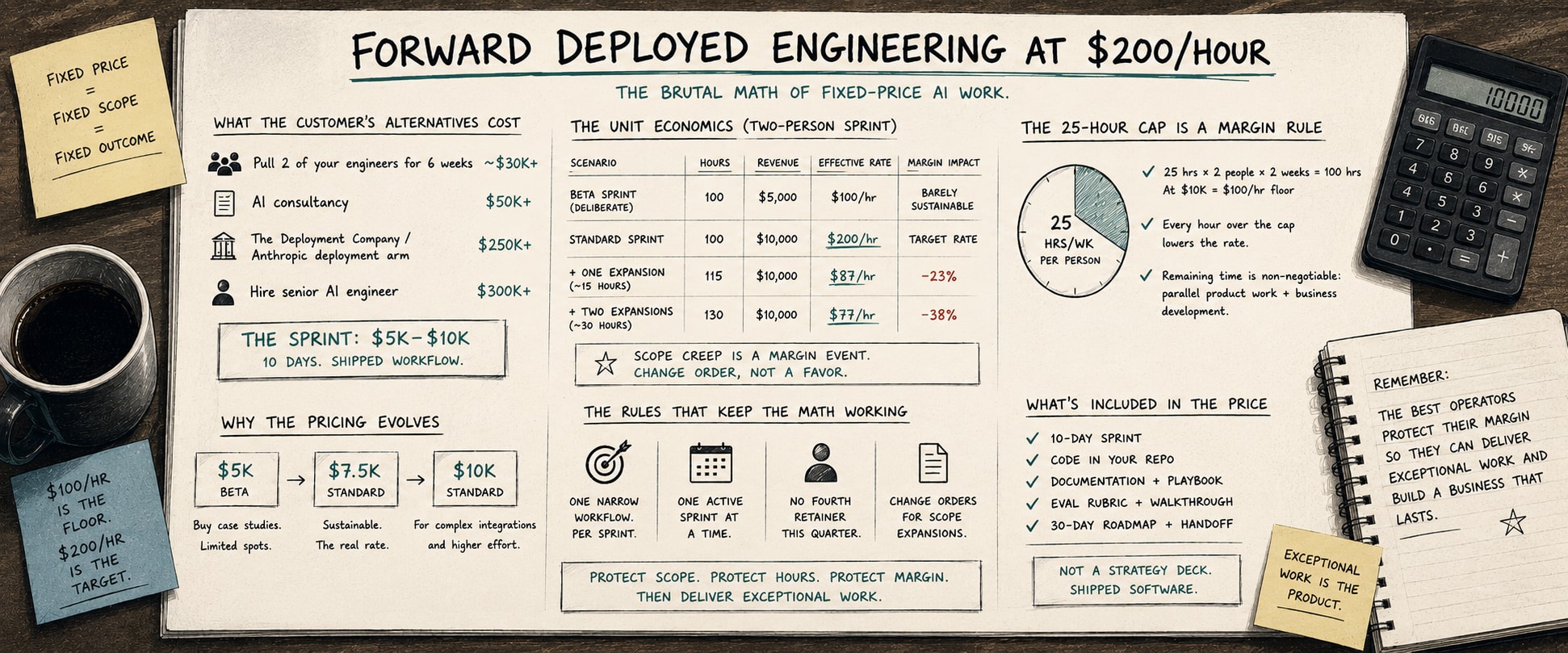
By the end of this article, you should understand why Forward Deployed AI Engineering for founder-led B2B SaaS sits at a specific price point ($5K beta moving to $7.5K to $10K standard) and why the operators who try to undercut that pricing are running their businesses into the ground in slow motion.
I run a 10-day Sprint business. The pricing is deliberate. The 25-hour-per-week cap is deliberate. The “no more than one active sprint at a time” rule is deliberate. The “no fourth retainer customer this quarter” rule is deliberate.
All four exist because the unit economics of senior-operator AI work are brutal at the wrong scope. Most operators don’t run the math until they are already underwater. This is the math.
What the customer’s actual alternatives cost
The most common pushback on the Sprint price is some variant of “ten days of work seems like a lot of money.”
The alternatives don’t seem like a lot of money once you do the comparison.
Pulling two of their own engineers off the roadmap for 6 weeks to figure out AI workflows: roughly $30K in fully-loaded salary, plus the opportunity cost of the roadmap slip. And the AI work probably still doesn’t ship. Internal teams without prior AI shipping experience succeed maybe half the time on the first attempt.
Hiring an AI consultancy: $50K minimum, 8 to 12 week timelines, decks and recommendations as the primary deliverable, code as an afterthought.
Buying from The Deployment Company or Anthropic’s deployment arm: $250K minimum, quarterly procurement cycle, security review longer than the work, designed for Fortune 500.
Hiring a senior AI engineer in-house: $300K all-in, 6 to 9 month search cycle, plus the rest of the engineering team having to onboard them.
The Sprint at $5K to $10K, fixed price, 10 days, with someone who has shipped this kind of work before, is not the expensive option. It is the cheap option. The buyer comparison is not “this Sprint versus a freelancer.” It is “this Sprint versus all of the above.” Once that comparison is on the table, the price discussion mostly disappears.
Why fixed price only works at narrow scope
Most software engagements run on time and materials. The work is open-ended. The total cost is unknown until the engagement ends. The customer is miserable by month two.
Fixed-price-for-fixed-outcome is only honest at a narrow scope. The Sprint can quote a number with confidence because the scope is narrow enough to be predictable. The customer can compare that number against their alternatives and decide cleanly. Everyone sleeps well.
The minute the scope widens (”one workflow plus ongoing support” or “an AI strategy plus implementation”), fixed pricing becomes either a gamble that bankrupts the operator or a buffer that makes the customer overpay. Neither is sustainable.
That is why the offer is one workflow, not “AI consulting.” It is not a marketing choice. It is the only structure where fixed pricing is honest. Widen the scope and you have to switch to T&M, and the moment you do, the cost certainty that justified the price in the first place evaporates.
The unit economics, in plain numbers
For a two-person operation working a single Sprint together, here is the actual math.
Beta Sprint: $5,000 divided by (25 hours/week × 2 people × 2 weeks) = $100/hour blended.
Standard Sprint: $10,000 divided by 100 hours = $200/hour blended.
Standard Sprint with one 15-hour scope expansion: $10,000 divided by 115 hours = $87/hour. Margin loss: about 23%.
Standard Sprint with two scope expansions: $10,000 divided by 130 hours = $77/hour. Margin loss: about 38%.
Two things follow from this directly.
The $5K beta price is barely sustainable. It exists to buy case studies, not to be a long-term rate. Sprints at beta pricing are loss-leaders against a $200/hour target. Once the first three beta sprints close, the price moves to $7.5K to $10K.
Scope creep is not an operational annoyance. It is a margin event. Every unplanned hour comes out of the operation’s ability to fund the rest of the month, fund parallel product work, and fund the time required to write the rubric and playbook properly.
That is why scope expansion is treated as a change-order conversation, not a yes-or-no question inside the sprint. The change-order isn’t bureaucracy. It is the mechanism that keeps the math working. “Yes, we can build that too. That is a separate scope, here’s what it would cost, want to discuss after Day 10?” Almost every customer will accept that framing. Almost no customer will accept “yes, we’ll throw it in.” They will just take it, then notice you delivered the original work worse than promised, and remember that.
The 25-hour cap is a margin rule, not a wellness rule
Sprint delivery is capped at 25 hours per week per person, by hard rule.
People assume the cap is a wellness rule. It isn’t.
25 hours/week × 2 people × 2 weeks = 100 hours of capacity per sprint window. At a $10,000 fixed price, that is $100/hour. That is the floor below which the business loses money on its own foundation: overhead, taxes, time required for handoff deliverables, time required for the parallel product work, and business development that justify the senior pricing in the first place.
Every hour over the cap directly lowers the effective rate. Twenty hours over, and the operator is working at a freelancer’s rate while taking senior-operator risk. That is how service businesses go broke profitably.
The remaining time in the week is non-negotiable. It goes to two things: parallel product development (the proof-of-work that justifies the pricing; the operator who isn’t shipping AI in their own product can’t credibly charge to ship AI in someone else’s), and business development (without which the pipeline collapses).
Why underpricing destroys the offer
A common impulse for new operators is to undercut: $1,500 for a “starter sprint,” $2,500 for a “lite engagement,” $750 for a “discovery call.”
Underpricing destroys the offer in three ways.
It signals low quality. Serious B2B buyers read prices as a signal. A $5K Sprint reads as a credible operator. A $1,500 sprint reads as a freelancer. Buyers self-select into the wrong bucket. The $1,500 sprint attracts buyers who haggle over $200 invoice line items.
It generates volume that the operator can’t sustain. A $1,500 sprint produces a customer who expects $1,500 worth of attention but requires the same support, communication, and handoff package as a $10K customer. Two of them in parallel collapse the operation.
It leaves no margin to deliver well. The rubric and playbook each cost about 2 hours to produce well. The handoff session is 60 to 90 minutes plus prep. The 30-day roadmap is another hour. At $1,500, those hours don’t exist. The deliverables either get skipped or get done badly. Neither produces case studies. The operation loses the next sale before it is even pitched.
A 7-day sprint at $1,500 is bad math. A 10-day sprint at $5,000 to $10,000 respects both sides: enough margin for the operator to deliver well, enough fixed scope for the customer to plan around.
The capacity rule
One active Sprint at a time. Not two. Not three. One.
The reason isn’t preference. It is the deliverables that distinguish Forward Deployed work from freelance work (the rubric, the playbook, the walkthrough, the handoff session) that require the operator’s full attention during Days 6 through 10. Two simultaneous sprints in those days produced two half-baked handoff packages and two unhappy customers. The math on one $10K sprint delivered well beats the math on two $10K sprints delivered badly, every time, over any time horizon longer than a quarter.
The same logic applies to retainer customers, once that offer is active: a maximum of three in parallel. Past three, the math collapses again.
Saying no to new Sprints when retainers are at capacity isn’t lost revenue. It is a protected capacity for the customers already paying. Every service business that fails fails because it said yes too often: yes to wrong customers, yes to scope creep, yes to capacity it didn’t have.
TLDR
The Sprint price ($5K beta moving to $7.5K to $10K standard) is not expensive next to the customer’s real alternatives: internal engineers ($30K+), AI consultancies ($50K+), enterprise FDE shops ($250K+), in-house AI hires ($300K+).
Fixed-price-for-fixed-outcome only works at a narrow scope. Widen the scope, and you have to switch to T&M, which destroys the cost certainty that justified the price.
Scope creep is a marginal event. One 15-hour expansion drops the effective rate by about 23%. Two drops it by about 38%. Treat every expansion as a change-order conversation, not a yes-or-no question.
The 25-hour-per-week cap is a margin rule, not a wellness rule. 100 hours × $100/hour = the floor below which the business loses money.
One active Sprint at a time. Three retainers max. Saying no protects capacity for customers already paying.
If you are running a service business that ships AI work and you can’t figure out why the math feels worse every quarter, the diagnosis is almost always one of these four: prices set too low, scope set too wide, capacity overbooked, or no change-order discipline. None of them is visible until they compound. All of them are fixable, but only before the operation has trained customers to expect the wrong shape of work.
The math doesn’t care how nice an operator you are. The math is the math.
If this topic is useful to you, I go deeper in my book, Forward Deployed AI Engineering: A Working Guide to the Hottest Job in Software.
It’s available now on Amazon: https://www.amazon.com/Forward-Deployed-AI-Engineering-Software/dp/B0H3VKKG38/