

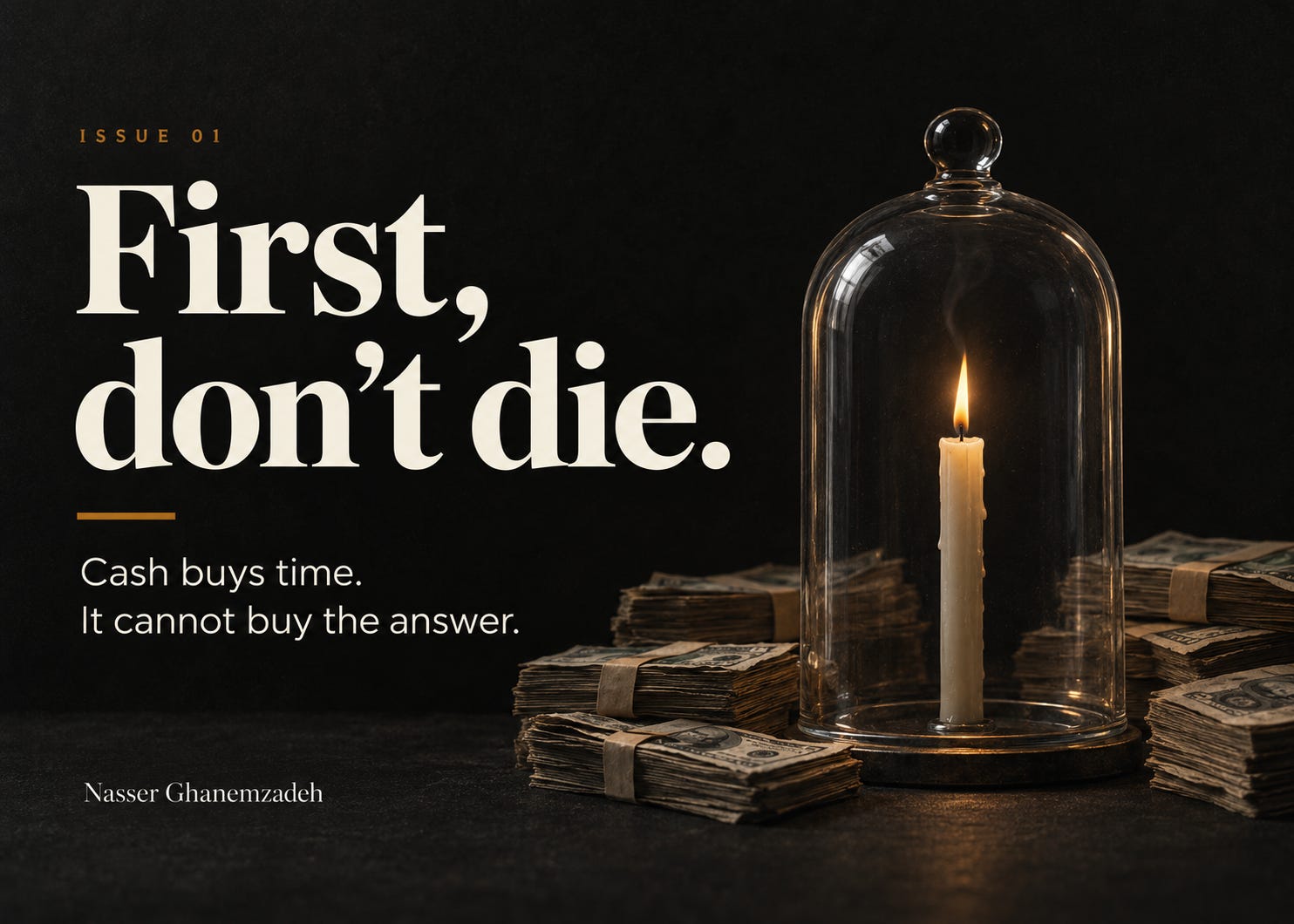
The model: cash is oxygen
Ask what kills startups, and the autopsies cluster: ran out of cash, no market need, wrong team, outcompeted. Look closer, and most of them reduce to one cause. The company died before its learning could pay off.
Unprofitability is survivable. Most great companies were unprofitable for years. Cash exhaustion is a different event on a different clock: profit is an opinion about a flow, and the bank balance is the stock that kills. Dickens gave Mr. Micawber the whole theory in one line. “Annual income twenty pounds, annual expenditure nineteen nineteen and six, result happiness. Annual income twenty pounds, annual expenditure twenty pounds ought and six, result misery.” Paul Graham gave founders the working version: default alive or default dead. On the current trajectory, does the company reach profitability before the money runs out? Most founders, he noticed, do not know their own answer.
If you are the one writing the check, the question changes chair without changing shape. Before the first dollar: is this company default alive or default dead, and does the founder know which? The answer has to be computed, and the founder has to be the one who computed it. Months of runway at current burn, the specific event that flips the answer, and the plan if that event misses its date.
Runway surprises people for reasons that are all in the book. Growth eats cash even when the unit economics work, because receivables lag and hiring precedes revenue, and everything takes longer than the plan, revenue most of all. And the fundraising environment is weather. The round that was easy in the boom is unavailable in the bust, on a schedule nobody publishes in advance. Howard Marks likes to quote The Economist’s rule of the credit cycle: the worst loans are made at the best of times. So are the worst equity checks.
Every strategy a company has is conditional on being alive to run it. That sounds obvious and is violated constantly, because the virtues startup culture celebrates are survival’s natural enemies when they go unpriced: boldness, speed, burned boats, the all-in round. The founder who bets the whole company on one launch or one round has built a coin-flip game with positive expected value per play and ruin somewhere on the path. The alternative is sequencing. Take the bold risks in recoverable sizes and keep the terminal risks off the table entirely. Staying in the game is the asset that buys you more draws, and in a domain this luck-heavy, more draws is most of the strategy.
There is a twist for the well-funded, and it is the one that matters this week. The companies that raise the most at the peak often perform worst, and the vintages founded in downturns keep producing outsized survivors. Scarcity enforces the disciplines automatically. With eighteen months of runway and no next round assured, unit economics get computed honestly, because you cannot afford the flattering version, and hiring waits for proof. Abundance suspends the enforcement. Bad ideas live past their kill dates and the burn rate quietly becomes the strategy. Nobody got stupider. The money removed the feedback that had been doing the thinking.
Which raises the question an investor should ask before the survival math, and which the survival math cannot answer: is there a problem worth having? The most common death certificate, “no market need,” describes a strange fatality. The company built something, shipped it, and found that nobody’s life had a hole of that shape. The test is pain, and the signals are behavioral. People have built spreadsheet workarounds, or are already paying for a worse solution. They chase you after the demo instead of politely accepting a follow-up. Vitamins get compliments and churn; painkillers get budgets. The sharpest version is one question. Is this product bought, or merely liked?
Cash buys time to find that out. It cannot buy the answer. This week’s case is the cleanest proof of that I know.
The case: $1.75 billion, six months
Quibi was founded in Los Angeles in August 2018, under the name NewTV. By the time it launched, in the first week of April 2020, it had raised $1.75 billion from a cap table that read like an industry directory: Disney, NBCUniversal, WarnerMedia, Alibaba, Goldman Sachs, JPMorgan, Sony, MGM, Viacom. Jeffrey Katzenberg, co-founder of DreamWorks, was the founder. Meg Whitman, formerly CEO of eBay and of Hewlett-Packard, was the CEO. Spielberg and Reese Witherspoon were among the names attached. The product was Hollywood-quality video in chapters of ten minutes or less, mobile only, made for people out and about, at $5 a month after a 90-day free trial.
On October 21, 2020, six months after launch, Katzenberg and Whitman posted an open letter to employees and investors. “Quibi is not succeeding,” it began, and offered two possible reasons: the idea was not strong enough to justify a standalone service, or the timing was wrong. They wrote that they would never know which. Roughly $350 million was left to return to shareholders. The content library sold to Roku the following January for under $100 million.
Run it through the model.
Quibi is the one company in the dataset that could not die of cash. That is what makes it useful. Strip out the usual cause of death and you can see the other one in isolation. The runway and the default-alive date would have come back green on any checklist, and the company died anyway, because the check had bought time to find a problem worth having, and none was found at that price in that format.
Look at what the money did to the feedback. A startup with eighteen months of runway learns in its first quarter whether the product is bought or merely liked, because it has to. Quibi launched with a 90-day free trial and enough cash to run for years at any burn. The market’s first honest signal, the conversion at the end of the trial, could not arrive before July. By the time the company shut in October, about $1.4 billion of the $1.75 billion was gone. The founders’ own letter says they cannot separate the bad idea from the bad timing. That is what abundance does. It removes the cheap early no that would have told them.
Now the investor’s chair. Everything in the pitch was the story: two of the most successful executives in American business and a new form of storytelling with Spielberg attached. Nothing in the pitch could have been the mirror, because the behavioral evidence did not exist yet. There was no spreadsheet workaround for “I wish my phone had ten-minute Hollywood.” There was no worse solution people were already paying for. There was a hypothesis, and the checks were sized as if it were a fact. The book’s sequencing rule says take the bold risk in a recoverable size. The recoverable size for “will people pay $5 a month for this” is a few million dollars and one launch. The cap table put the terminal size on the table first.
One decision in the story does pass the model, and it deserves credit because it is rare. When the answer came back, Katzenberg and Whitman shut the company with $350 million still in the bank and sent it home. Katzenberg told Deadline that carrying on would only have spent more money for the same result. That is throwing good after bad, refused, which gets its own page on March 7. Most founders in that position raise a bridge. He wrote an apology instead.
The tool: six questions before you wire money
Ask them in the meeting, in this order, and write the answers down before the outcome exists.
Default alive or default dead? Months of runway at current burn, the date the money runs out, and the specific event that flips the answer. A founder who says “we’ll raise” has answered a different question.
Who pays what, today, to solve this badly? One sentence with numbers in it, hours or dollars. If the sentence has no numbers, the need is still hypothetical.
Bought, or merely liked? Ask for the last five customer conversations, in the past tense. “Walk me through the last time you had this problem” beats “would you use this,” because everyone is generous with fictional money.
What is the one thing? The single bet that, if it works, makes everything else easier or unnecessary. Then ask what the second hare is, and how much it is still being fed.
What are the unit economics of the worst honest cohort? Fully loaded, by channel, never blended. If negative, which specific cost falls, why, by how much, and by what date.
What single event could kill this company in the next twelve months? And what is it costing, in speed or pride, to take that event off the table.
Six good answers tell you the founder has done the arithmetic, which is a different thing from a good deal. One bad answer tells you what the check would actually be buying.
The pages behind this letter: October 1 to 8 in Daily Wisdom, from “First, don’t die” to “The discipline of scarcity.” The letter runs a little ahead of the book until January, on purpose: you read the idea here before you reach the page. Nothing here is investment advice; the letter is about the quality of decisions, not returns. Reply with the decision you are facing. The ones I can use, with the details changed, become cases.
P.S. Daily Wisdom is on pre-order and ships October 6: [AMAZON LINK].