

The model: the avoidance edge
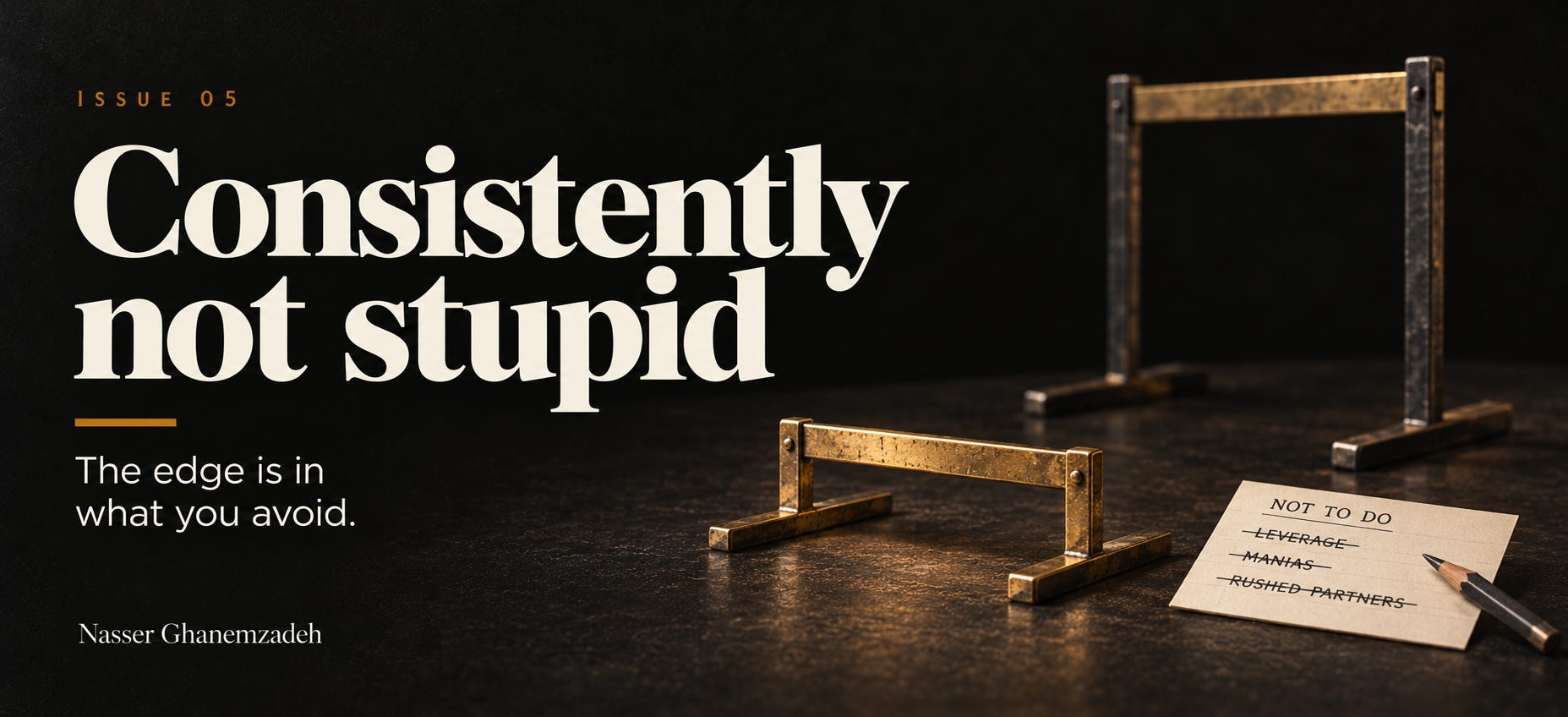
“It is remarkable how much long-term advantage people like us have gotten by trying to be consistently not stupid, instead of trying to be very intelligent.” Munger is not claiming brilliance is worthless, or that Berkshire won by accident. He is observing where the returns actually came from, and his answer is avoidance: the leverage not taken, the manias not joined, the reputations not gambled, the partners not chosen in a hurry. Buffett said the same thing in the 1989 letter, after twenty-five years of buying businesses. He and Munger had not learned to solve difficult business problems. They had learned to avoid them, looking for one-foot hurdles to step over rather than seven-foot ones they might clear.
The arithmetic behind the claim runs through the whole book. Errors are asymmetric: losses need outsized gains to repair, and some end the game, so no accumulated brilliance survives one act of terminal stupidity. Errors are also more predictable than successes. Nobody can list next decade’s winning ideas, but the standard failure modes have been constant for centuries, and February’s catalog of them has never needed an update. Avoiding the known and recurring beats predicting the unknown, on reliability alone. And the competition is thinner. The pursuit of brilliance is crowded with ambitious people bidding up the price of cleverness. The pursuit of non-stupidity is nearly deserted, because it is unglamorous, invisible when it works, and pays in disasters that never happened. Munger’s folk saying completes the thought. It is the strong swimmers who drown.
November in the book runs on the engine of Munger’s 1986 commencement speech at the Harvard School, which prescribed guaranteed misery and let the audience invert. The first four prescriptions are this week’s pages, and every one of them is a road an investor can take by accident.
Be unreliable: do not quite do what you said you would do. Inverted, it is the cheapest edge in professional life, and the bar is rarely cleared because most people are mostly reliable. A 90 percent reliability rate compounds like any other 90 percent. Twenty commitments in, the mostly reliable person has broken two, and trust is a stock that drains on exceptions. For an investor the promises that count are the ones made to founders: the follow-on you implied, the introduction you offered, the decision you said would come by Friday.
Learn only from yourself. The arithmetic is brutal. Your own life supplies a few decades and one vantage point; the recorded experience of others supplies every documented disaster since writing began, free. The November flavor is to learn especially from other people’s failures, because success stories are survivorship-filtered and narrated backward, and failure stories are cleaner. The bankruptcy filing, the post-mortem, the fraud unraveled in court documents, the shareholder letter that confesses: each is a mechanism laid bare, because failure requires explanation while success gets to pose. Munger was a lifelong collector of disasters, on the theory that knowing where you will die is the practical form of immortality.
Go down and stay down: let the first serious reverse become the permanent verdict. The mechanism that keeps people down is rarely the blow. It is the story attached to it, the setback read as identity instead of as one draw from the urn. And fuzzy thinking, which requires no effort at all, since objectivity is the discipline that has to be installed and the misery-seeker simply relaxes.
From the investor’s chair the whole week reduces to one question, asked before any brilliant addition: which two of my own stupidities are repeatable, and what would deleting them be worth this year?